Luckin Coffee released a new "Fair Isle latte", which has aroused a lot of curiosity.
Only the cups, cups and paper bags of Luckin Fair Island coffee are decorated with red, white and blue snowflakes, and the beige sweater worn by the spokesman Yi Yangqianxi also has brown snowflakes and stars.

"What's so different about this Fair Isle coffee?" In this regard, Luckin explained in the official Twitter that "Fair Island coffee" does not refer to a certain flavor of coffee, among which "Fair Island" is a pattern that has been circulating for centuries.
So, what exactly is Fair Isle? What does this pattern have to do with Fair Isle? Where is Fair Isle?
Fair Isle pattern, a timeless classic
The Fair Isle pattern, as the name suggests, is derived from Fair Isle in the United Kingdom. Due to the abundance of wool on the island, coupled with the wet and cold climate, the residents of the island woven a variety of fabrics with local patterns, which later became collectively known as the "Fair Isle Pattern".
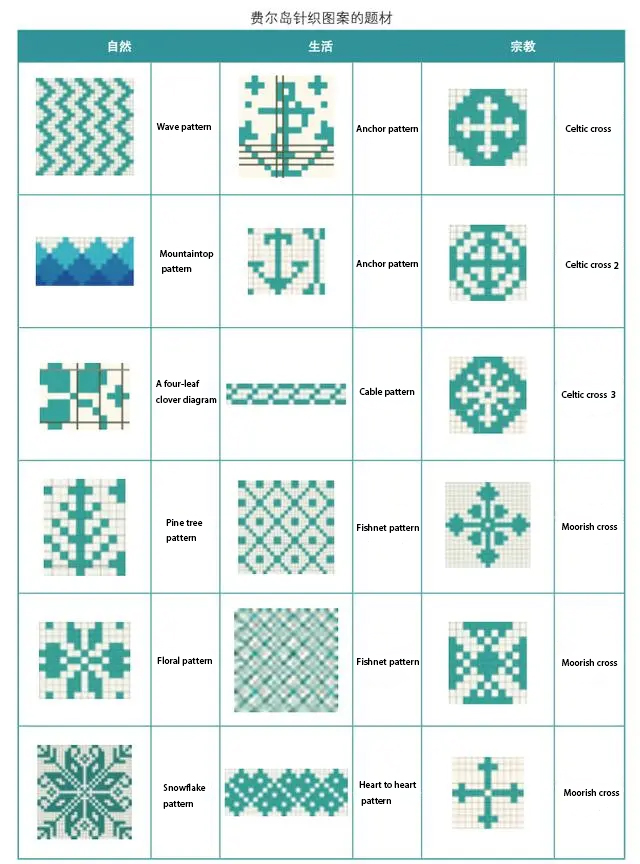
The knitting patterns of the Fair Isle pattern mainly come from three aspects of nature, life and religion, there are natural patterns related to the environment of the Fair Isle such as waves, mountains, pines, as well as patterns related to the nautical life of the island such as anchors and fishing nets. Due to the Christian faith of the Fair Isle people, and the influence of the neighboring Northern Europe, the Fair Isle pattern will also appear from time to time Celtic crosses, Moorish crosses and other patterns.
The most common place the Fair Isle pattern appears is in
sweaters.
In order to keep out the cold, Fair Isle sweaters often use double-layer knitting to increase the thickness, and the elements of pine, snow, reindeer and other patterns are easy to remind people of Christmas trees and Santa Claus, so Fair Isle sweaters are very popular in winter. In quite a few movies and TV shows, you can see the existence of Fair Isle sweaters. In "Sherlock", Watson and Molly, the medical examiner, have worn sweaters with Fair Isle patterns.

In the film Game of Cats and Mice, Leonardo also wears a Fair Isle sweater and dances with his mother on Christmas Day.

Fair Isle pattern into China is not a late time. In the 1990 publication of the "mohair knitting", you can already see the "Fair Isle pattern" record, the book also describes in detail the design and weaving of the Fair Isle pattern, the actual introduction should be no later than the 1980s.
Whether it's nostalgia or fashion, there's always a place for Fair Isle patterns in autumn and winter. In addition to popular sweaters, Fair Isle pattern is also widely used in gloves, scarves and other aspects.

How did the Fair Isle Pattern come into being
To investigate the origin of the Fair Isle pattern, we must start with the geographical location of Fair Isle.
Fair Isle is located in northern Scotland (59°32 '30 "N, 1°37' 21" W) and is part of the Shetland Islands. The name Fair Isle has two variations: a variant of "Far-off Isle", and from the Old Norse "Friðarey", meaning "small island of peace". Isolated and almost isolated, Fair Isle is indeed quiet.
Map of the Shetland Islands, 1636, with Fair Isle at the bottom | Credit: National Library of Scotland
Fair Isle was inhabited as early as the Neolithic Age. From the 9th to the 15th centuries, Fair Isle was part of Norway. In 1469, the daughter of the King of Denmark, Margaret, married King James III of Scotland, and the Shetland Islands, including Fair Isle, were given to Scotland as dowry. In 1707, Fair Isle became part of the United Kingdom when Queen Anne merged the Scottish and English parliaments to form the United Kingdom of Britain.

Fair Isle is poor in materials and soil, and its main industry is sheep farming.
According to Amy Liptrot, a British writer who visited Fair Isle, sheep on the island had to be "brought in by sling and pulley" from ships and returned to ships in the same way. Under the hard work of the Fair Isle people, wool has become an important product of the island. In addition, affected by the temperate maritime climate, the island is also rich in a variety of lichen plants with dyeing effects, which provide material conditions for the production of Fair Isle patterns.
Another school holds that the Fair Isle pattern was taught to the Fair Islanders by the Spanish.
In 1588, a warship of the Spanish "Armada" was shipwrecked in the waters east of Fair Isle, and the Duke of Medina and his crew accidentally landed on the island and taught the islanders the knitting method of southern Spain in exchange for food. However, visitors to Fair Isle before the 19th century did not mention the island's specialty woven goods, and perhaps the history of Fair Isle patterns is not as old as we think.
No matter where it comes from, from Norway to the United Kingdom, 600 years of history, Fair Isle pattern in highlighting the British style at the same time, inevitably with a trace of Nordic mystery. It was in the middle of this culture that the Fair Isle pattern was born. Coupled with the isolation in the sea and the harsh climate, out of the need to keep out the cold or exchange goods, the islanders of Fair Island gradually began to weave sweaters and other wool products, and gradually formed their own style.
A couple on Fair Isle in the 1970s
How did the Fair Isle Pattern spread around the world?
Many people believe that the "first appearance" of the Fair Isle pattern originated from the "cargo" of the British Prince of Wales in the 1920s (that is, the later King Edward VIII of the United Kingdom, after the abdication of the throne, the "Duke of Windsor"). In fact, as early as the first Great Exhibition held in London in 1851 (the predecessor of today's Expo), Fair Isle pattern has become a representative of Shetland Islands and even Scotland, attracting considerable attention.
However, in the mid-19th century Fair Isle was almost the most difficult place to communicate with in the UK, and even with a certain reputation, it was not easy to get a Fair Isle sweater.

In 1870, Shetland opened a fixed air route and postal service, and tourists began landing on the island and taking the island's knitting specialties with them when they left. In 1921, Fair Isle residents presented several Fair Isle sweaters to the then Prince of Wales. The Prince of Wales has since worn his favourite Fair Isle sweater on a number of important occasions, saying that "of all my clothes, the most dazzling is the multi-coloured Fair Isle sweater".

The royal family strongly recommended, so that "Fair Isle" in the UK household name, a variety of books teaching Fair Isle flower weaving method sold, the private demand for Fair Isle sweaters also increased rapidly. In 1924, in order to ease the pressure on orders, several samples of Fair Isle sweaters were sent to Scotland for manufacturers to learn, opening the era of mass production of Fair Isle sweaters.

During World War II, all kinds of military facilities were built on the inaccessible Fair Isle to defend against the German invasion, and the island became one of the landing points for Allied ships. The colorful fabrics of Fair Isle also aroused the curiosity of American soldiers. After the German invasion of Norway in 1940, a large number of Norwegian refugees fled across the sea to the Shetland Islands, and they further combined the Nordic knitting pattern with the local pattern of the Fair Isle, and after the end of the Second World War, the name "Fair Isle" back to Northern Europe. The fame of Fair Isle gradually spread from Britain to the United States and continental Europe.
Times have changed. Since 1950, due to the harsh environment and single industry on the island, many islanders have left Fair Isle and gone to the British mainland, the United States and Canada, producing "Fair Isle" all over the world. In the 1960s, the automatic knitting machine that can weave the Fair Isle pattern was invented, and the production of the Fair Isle pattern entered the machine age. With the development of the fashion industry, starting from the United States and the United Kingdom, Fair Isle pattern gradually appeared in various shows, from the island to the world.
Seventy years ago, thanks to the promotion of knitting books and the British tradition of knitting sweaters, British housewives often knitted several Fair Isle sweaters for their families. Similarly, wearing a sweater made by the family is also a childhood memory for many Chinese today.
In the fast pace of life, knitting is difficult and time-consuming, and is not suitable for modern people to easily challenge. But you can still warm up with a hot Fair Isle latte.
The above information is from the network, does not represent the opinions of this site, if you have questions please put forward.