The charm of dressing lies not in following trends, but in presenting your own style with basic pieces. Ruth uses the main colors of off-white, navy blue, and dark brown, along with a red cashmere bag or a silk scarf knot, to prove that comfort and attractiveness can coexist - the same pair of loafers can be paired in ten different looks, and the truly high-end item is the one you are willing to wear repeatedly.
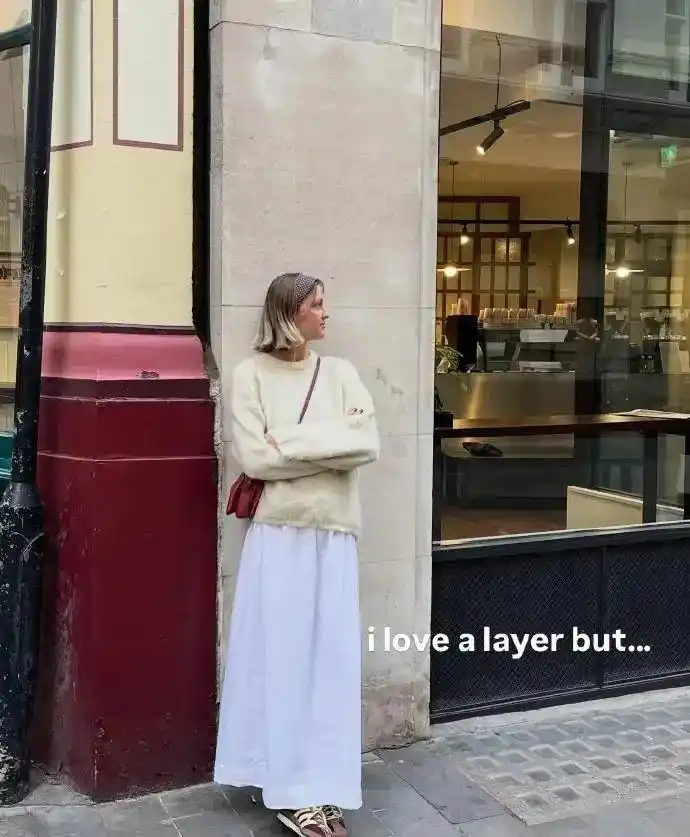
When spring still had a touch of coolness, Ruth wore a light beige fleece sweater on her upper body, paired with a white long skirt that reached the ankles. She carried a small bag in a wine-red color across her shoulders. She wrote, "I love layers but...". As soon as this sentence was uttered, many people immediately understood. The little thoughts of not wanting to be too cold while still wanting to look good were all contained in this outfit. When the sun made the city a bit too hot, she put away her thick coat and changed into a white shirt paired with a navy blue striped short skirt. She wrote, "It's time to thaw!" The sense of ease from going from cold to warm was brought out along with the photo.
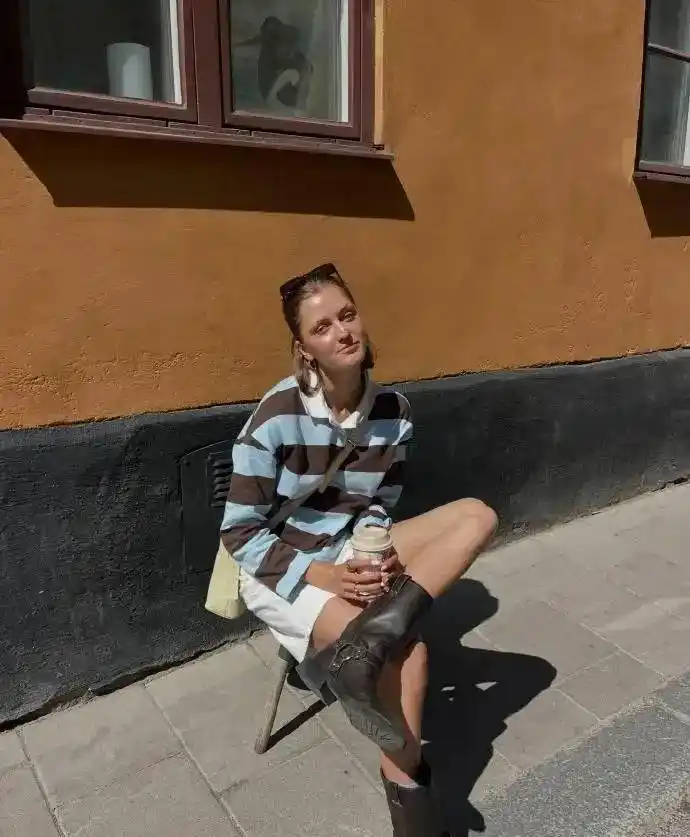
There weren't many colors in Ruth's wardrobe. They were mostly beige, navy blue, brown, and black. It looked simple, but she always managed to combine these clothes to create a different feeling. A polo shirt with blue and brown stripes paired with white shorts, a pair of brown motorcycle boots on her feet, she leaned against an old building. Many people would think, "Isn't this just everyday items?" But when she wore them, there was a very pleasing sense of harmony. Once, she wore a pink floral necktie top, paired with a navy blue wide-leg skirt, and black shiny leather shoes on her feet. Standing by the red brick wall, she seemed to have placed the past and the present in the same photo. It was both everyday and had a touch of old photo flavor.
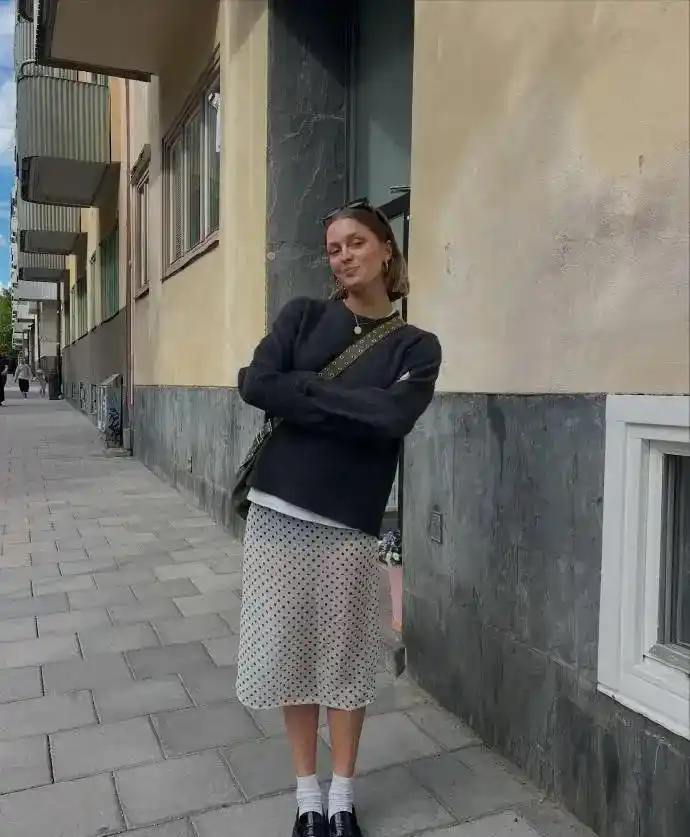
The black and white polka dot midi skirt is a style that is commonly found in many people's wardrobes. She paired it with a dark grey sweater, along with white socks and black loafers. When this combination was presented, many people would think of the neat and tidy look of an English school uniform. When the polka dots became a full-length dress, she added red wine-colored ankle socks. Walking on the cobblestone road, the person suddenly became more lively. The same polka dots, the same basic colors, but due to different combinations, the entire appearance completely changed.
The most interesting aspect of her actually lies in the small details. She would use a knitted hairband to simply tie her hair up, and her overall demeanor would elevate a bit; she would tie a silk scarf knot at the neckline, even if it was just an ordinary base layer, it no longer felt boring; sometimes, she would drape a wine-red knitted sweater over her shoulders, not to keep warm, but to break the monotony of the overall color; and her very common crochet hairband paired with a light white knitted vest, the colors are not jarring, but the presence is very strong, making it easy for people to remember at a glance.

The colors she uses have always been very restrained. This is reflected in the analyses by the Pantone color institute and many fashion data platforms. In daily outfits, the proportion of low-saturation colors used is often over 60% in street photography images. Ruth's choices are very close to such statistics. She has long stayed within the main colors such as off-white, navy blue, dark brown, and black. Only in small areas does she apply a touch of wine red or light green, such as a wine-red small bag, a light yellow underarm bag, or a black chain bag. This does not overshadow the main elements and can also draw the visual focus of the entire outfit.
In terms of shoes, she is even more consistent. She has been rotating between loafers, motorcycle boots, and casual sneakers for a long time. She does not chase trendy best-selling sneakers, nor does she stack complex designs. Often, the same pair of shoes can appear in different scenarios and different combinations. Such high-reuseability combinations are actually not exactly the same as the recommendations of many fashion magazines. Magazines often emphasize "new arrivals" and "must-have for the current season", while her approach is more like investing all the money in eye-catching and durable items. From a consumption perspective, this choice is somewhat against the trend, but from the actual wearing frequency, it is closer to the pace of life of ordinary people.
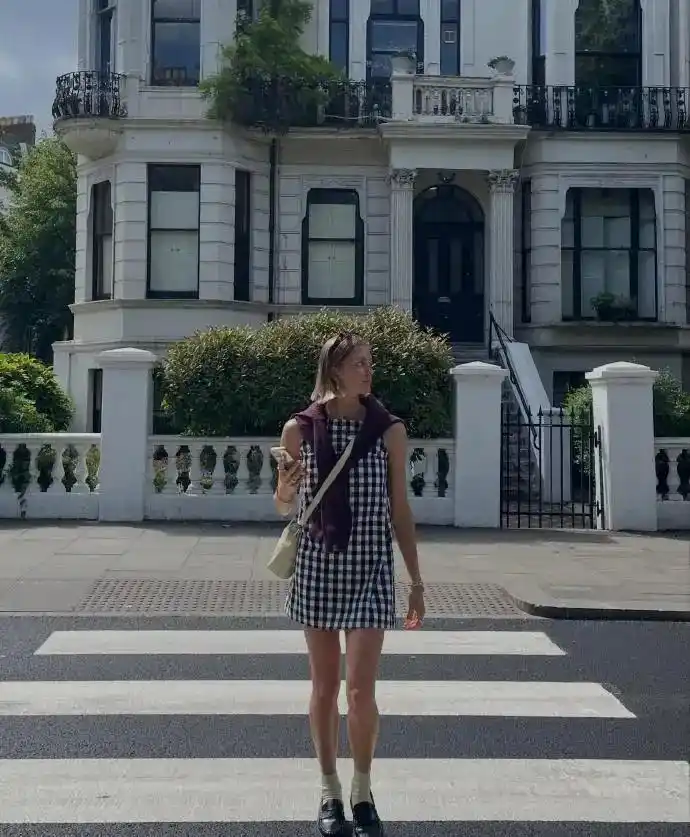
She wore a simple outfit and carried a small bag while strolling through the market in the streets of London. She could directly go grocery shopping, have coffee, and meet friends. When she reached the narrow alleys of the old town in Northern Europe, she changed into a long dress and wore a cardigan over it. She remained in the same effortless state. She didn't try to draw attention or deliberately seek out unusual angles. In her photos, you could see recurring items and see the same piece of clothing being recombined in different weather conditions and in different cities. This repetition itself indicates that she was truly wearing it, rather than just doing it for the purpose of taking photos.
Once, a blogger commented on her on social media, saying that her clothes were all similar and the colors were "boring" and didn't catch people's eyes. Such comments were quite common. On the other hand, some people in the comment section said that it was precisely because she wasn't flashy that it gave people the feeling of "you can buy them and wear them yourself", and it wouldn't be like watching a fashion show where one could only marvel at the beauty but dare not wear it out. When these two voices were combined, it clearly presented a question on the table: Is dressing for the purpose of being remembered by others, or for making one's daily life smooth?
From the perspectives of psychology and consumer research, many institutions have conducted surveys. The American Psychological Association and some fashion consumption research reports have mentioned that wearing clothes that make you feel at ease for a long time can enhance your sense of control over daily life and make your self-evaluation more stable. Ruth's choice precisely aligns with this point. She doesn't treat every day as a "makeup contest", but rather takes comfort as the bottom line, and adds a little touch of creativity on top of that, such as a hairband, a small bag, or a pair of socks. She places "looking good" and "being comfortable to wear" on the same level.
Her seemingly ordinary "stacked basic outfits" have gradually been regarded as a trend in some professional fashion reviews. Street photography data from Paris and Copenhagen shows that the frequency of repeated items has been increasing in recent years, indicating that more and more people are no longer obsessed with "one-time looks", but are starting to look for clothes that can be combined to create 10 or 20 outfits. Ruth's account is, to some extent, a sample of this trend. She has demonstrated to everyone the logic of an ordinary person's wardrobe: uniform colors, few items but stable quality, winning through combination rather than quantity.
This also brings about a rather revolutionary perspective: Truly sophisticated dressing is not necessarily about how expensive or unique the clothes are; rather, it's about whether you are willing to wear the same piece repeatedly. If you can wear something repeatedly, it means it is comfortable enough and suitable for you. Nowadays, many people pursue "not wearing the same outfit every day", which seems very meticulous, but in fact it is very exhausting. The closet gets fuller and fuller, and the few items that can be worn out are still the same few. Ruth uses her daily life to tell everyone that a fashion account doesn't have to rely on stocking new items to be attractive. As long as the repeated items are your own style, not someone else's template.
From the perspective of an observer, her photos lack grand scenes, no obvious "signature landmarks", and do not showcase luxurious elements. Such content is not particularly eye-catching in the information flow. However, once you click on her homepage and scroll down a few lines, many people will have a rare feeling: These clothes are affordable for me, I can wear them, and I can even go out wearing them. For ordinary users, this replicability is far more valuable than the "unattainable elegance".
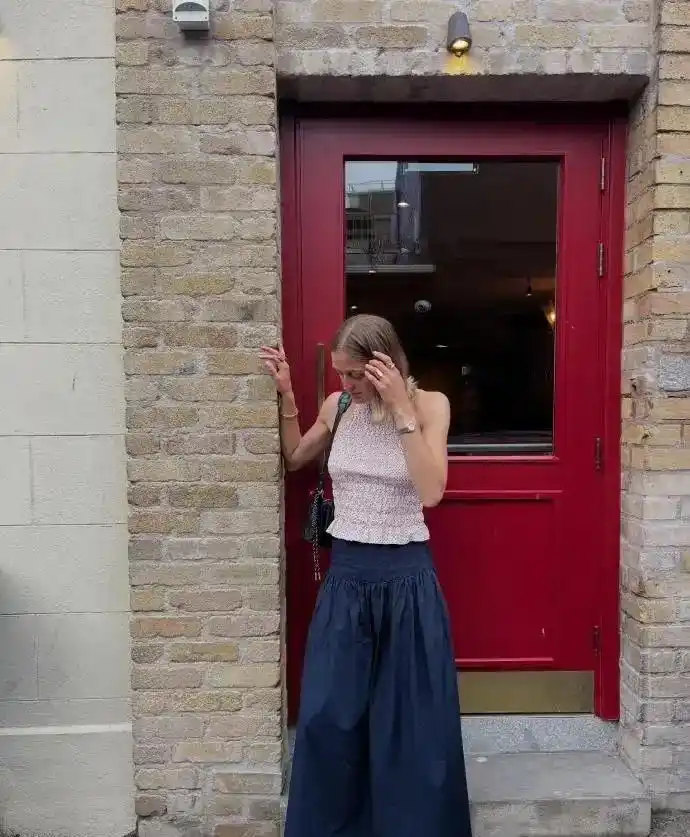
Ruth's way of dressing actually reflects a larger social phenomenon: In this increasingly fast-paced life, many people have begun to conserve some of their energy. They no longer devote all their energy to pleasing others, but instead focus on ensuring their own comfort first, and then gradually add a bit of desire to express themselves. The sense of relaxation, perhaps not a trendy term, is actually a choice: Accepting one's limitations, and within those limitations, wearing those few pieces of clothing that truly suit you to the fullest.